You've probably seen it on social media: someone cracks open Vitamin E capsules, squeezes the oil into a bottle of coconut or herbal hair oil, and claims they've made a "100% natural" hair treatment. Hair oil brands across Sri Lanka and South Asia do the same — they add externally sourced Vitamin E oil or tocopheryl acetate to their formulations and stamp "100% Natural" on the label. But is this really natural? And more importantly, could it introduce unwanted chemicals into a product you trust to be pure? This article breaks down the science — no marketing talk, just facts.
What Does "100% Natural" Actually Mean?
There is no universally regulated legal definition for "100% natural" in the cosmetics and hair care industry in most countries, including Sri Lanka. Unlike "organic" certifications (which require third-party audits), the word "natural" is largely self-declared by manufacturers.
However, by the commonly accepted understanding, a 100% natural product should contain:
- Ingredients derived directly from plants, minerals, or animals — without synthetic chemical processing
- No petrochemical-derived compounds
- No laboratory-synthesised molecules that don't occur in the natural source
- No artificial preservatives, stabilisers, or fillers
With this definition in mind, let's examine what Vitamin E supplements actually are.
Understanding Vitamin E: Natural vs. Synthetic — The Chemistry
Vitamin E is not a single molecule. It's a family of eight compounds: four tocopherols (alpha, beta, gamma, delta) and four tocotrienols. These occur naturally in plant oils, nuts, seeds, and green leafy vegetables.
Natural Vitamin E (d-alpha-tocopherol)
Natural Vitamin E exists as a single stereoisomer called RRR-alpha-tocopherol (also written as d-alpha-tocopherol). It's found in:
- Wheat germ oil — one of the richest natural sources
- Sunflower oil, safflower oil
- Coconut oil — contains natural tocopherols and tocotrienols
- Palm oil, rice bran oil
- Almonds, hazelnuts, peanuts
When these oils are cold-pressed or traditionally extracted, the Vitamin E they contain is genuinely natural. It was never separated from the oil — it's part of the oil itself.
Synthetic Vitamin E (dl-alpha-tocopherol)
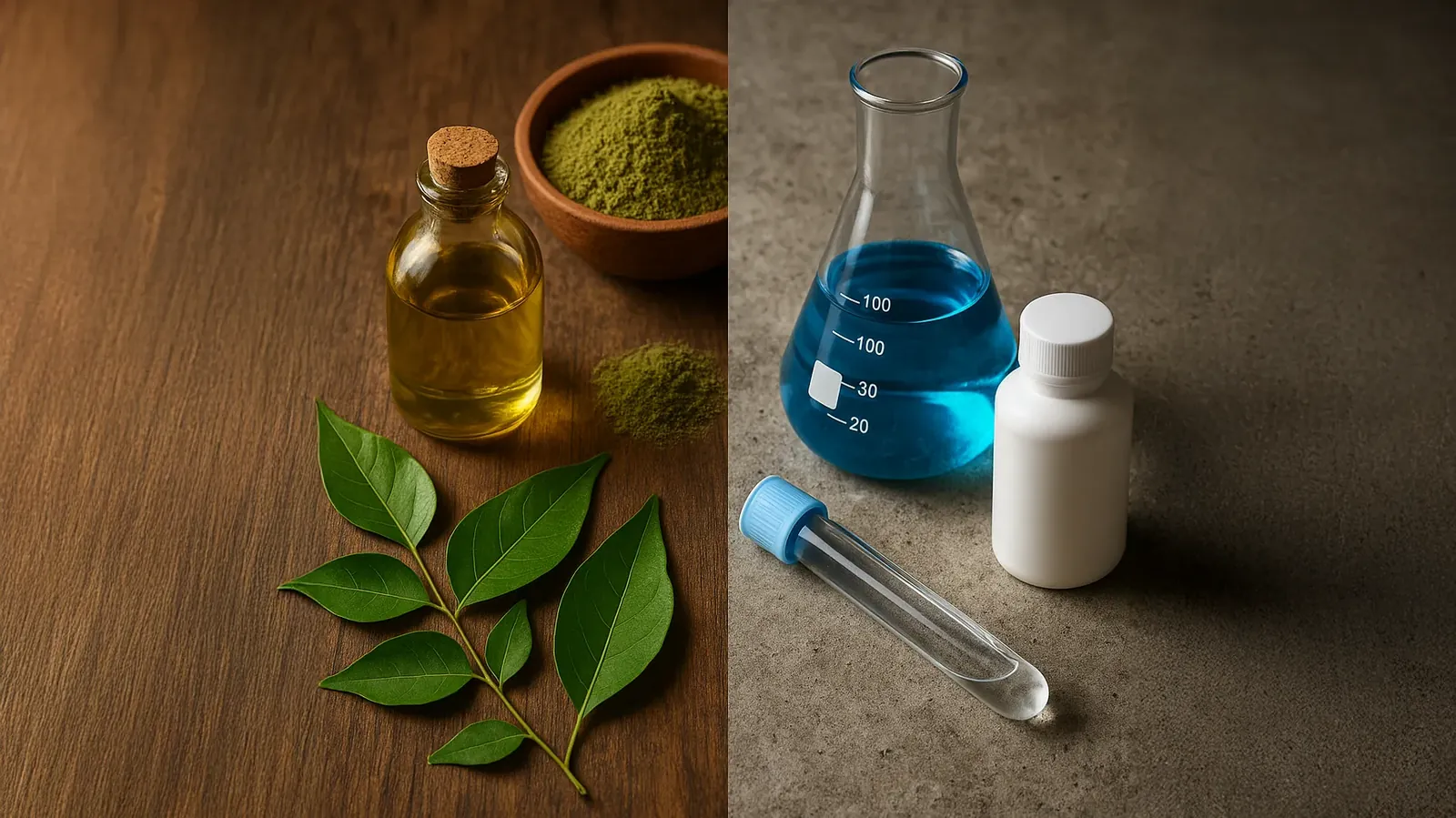
This is where things get concerning. According to scientific literature, synthetic Vitamin E — labelled as dl-alpha-tocopherol or all-rac-alpha-tocopheryl acetate — is manufactured industrially from petroleum-derived raw materials.
The manufacturing process, as documented by the European Food Safety Authority (EFSA), involves:
"It is synthesized from a mixture of toluene and 2,3,5-trimethyl-hydroquinone that reacts with isophytol to all-rac-α-tocopherol, using iron in the presence of hydrogen chloride gas as a catalyst."
— EFSA Scientific Opinion, 2012
Let that sink in: synthetic Vitamin E is derived from toluene (a petroleum solvent) and processed using hydrogen chloride gas. The final product is purified by vacuum distillation to >97% purity. The largest global manufacturers of this form are DSM and BASF — industrial chemical companies.
This synthetic form contains a mixture of 8 stereoisomers, only one of which (12.5%) matches the natural RRR form. The other 7 are molecular mirror-images that don't occur in nature.

What's Actually Inside Those Vitamin E Capsules?
When someone breaks open a Vitamin E capsule and adds it to hair oil, they're not just adding pure Vitamin E. A typical commercial Vitamin E capsule contains:
- dl-alpha-tocopheryl acetate (synthetic) or d-alpha-tocopheryl acetate (semi-synthetic) — the active ingredient in ester form
- Soybean oil or sunflower oil — as a carrier/filler
- Gelatin — the capsule shell (animal-derived)
- Glycerin — softener for the capsule
- Purified water
- Potentially: artificial colourants (like FD&C Red No. 40), preservatives, and stabilisers like BHT (butylated hydroxytoluene)
Key point: Even if the label says "Natural Vitamin E," the capsule still contains multiple non-natural processing aids and additives. When you squeeze this into hair oil, all of those ingredients go in — not just the tocopherol.
The Acetate Problem: Tocopheryl Acetate Is NOT an Active Antioxidant
Here's a fact that surprises most people: Vitamin E in capsule form is typically sold as tocopheryl acetate — an ester form. An ester is created by reacting the tocopherol with acetic acid.
Why does this matter?
- Free Vitamin E (tocopherol) works as an antioxidant because its exposed hydroxyl (-OH) group can donate a hydrogen atom to neutralise free radicals
- In the ester form (tocopheryl acetate), this hydroxyl group is blocked by the acetate ester bond
- This means tocopheryl acetate cannot directly act as an antioxidant when applied to hair or skin
As noted in scientific literature: "The ester form shields this group from oxidation, but this also prevents the ester form from directly acting as an antioxidant." When taken orally, your gut enzymes (esterases) can break this bond and release free tocopherol. But when mixed into a hair oil and applied topically, this de-esterification process is minimal.
In plain language: The Vitamin E capsule oil you're adding to your hair oil is largely inactive as an antioxidant in that form. It can slowly hydrolyse in the presence of water, but hair oil is anhydrous (no water), so even this slow activation is negligible.
Can Synthetic Vitamin E Cause Unwanted Chemical Effects?
This is the question consumer should ask. Here's what the scientific evidence shows:
1. Allergic Contact Dermatitis
Published research documents cases of Vitamin E-induced allergic contact dermatitis from topical use of derivatives like tocopheryl linoleate and tocopherol acetate in skin care products. While incidence is described as low, it's a real, documented phenomenon (Kosari et al., Dermatitis, 2010).
For people with sensitive scalps or existing conditions like eczema or seborrheic dermatitis, adding synthetic Vitamin E derivatives to hair oil could potentially trigger or worsen irritation.
2. Unnatural Stereoisomers on Your Scalp
Synthetic dl-alpha-tocopherol contains 7 stereoisomers that don't exist in nature. While these are considered safe for oral consumption at normal doses (the entire UL safety assessment is based on racemic studies), their long-term topical interaction with scalp microbiome and hair follicle biology has not been extensively studied. The human body recognises and preferentially uses the natural RRR form — the unnatural forms (especially the four 2S isomers) are poorly recognised by the alpha-tocopherol transfer protein.
3. Hidden Additives From Capsules
When capsule contents are squeezed into hair oil, you may be introducing:
- BHT (butylated hydroxytoluene) — a synthetic antioxidant preservative. BHT is classified as "possibly carcinogenic to humans" by some health bodies, though the evidence is debated. It's certainly not "natural."
- Artificial colourants — some cheaper capsules use synthetic dyes
- Residues from the gelatin shell — processed animal collagen
None of these belong in a product labelled "100% natural."
4. Rancidity and Stability Concerns
Ironically, while Vitamin E is added to prevent oil rancidity, improperly adding capsule oil can create the opposite effect. Commercial hair oil formulations are carefully balanced for stability. Adding a foreign oil component (the carrier oil inside the capsule) can alter the oil's oxidative stability, especially if the carrier oil is polyunsaturated (like soybean oil, commonly used in capsules). Polyunsaturated oils are more prone to oxidation than the saturated fats in coconut oil.
How to Tell If Your Hair Oil Contains Synthetic Vitamin E
Check the ingredient label carefully:
| Label Reads | What It Means | Natural? |
|---|---|---|
| dl-alpha-tocopherol or dl-alpha-tocopheryl acetate | Fully synthetic — made from petroleum derivatives | No |
| d-alpha-tocopherol or d-alpha-tocopheryl acetate | Extracted from plant oils but industrially processed; acetate form is semi-synthetic | Partially |
| Tocopherol or Mixed tocopherols | Extracted from plant oils — the free (non-ester) natural form | Yes |
| No Vitamin E listed — but uses cold-pressed oils like coconut, gingelly, or castor | Vitamin E naturally present in the oils themselves | Yes — Truly Natural |
The Truly Natural Way: Vitamin E That's Already in the Oil
Here's what many people don't realise: cold-pressed plant oils already contain natural Vitamin E. There's no need to add it externally. Consider these natural Vitamin E levels in common hair oil base ingredients:
- Coconut oil: Contains natural tocopherols and tocotrienols — these are part of the oil's natural composition
- Gingelly (sesame) oil: Rich in gamma-tocopherol and sesamin, powerful natural antioxidants
- Castor oil: Contains delta-tocopherol and gamma-tocopherol
- Rice bran oil: One of the richest sources of tocotrienols
- Mustard oil: Contains alpha and gamma tocopherols naturally
When a hair oil is made from these cold-pressed oils using traditional methods, the Vitamin E is already there — in its natural, bioavailable, free tocopherol form. It doesn't need to be "added."
Adding synthetic Vitamin E capsules to such an oil is not only unnecessary — it compromises the "100% natural" claim.
Why Does SidBoga Never Add External Vitamin E?
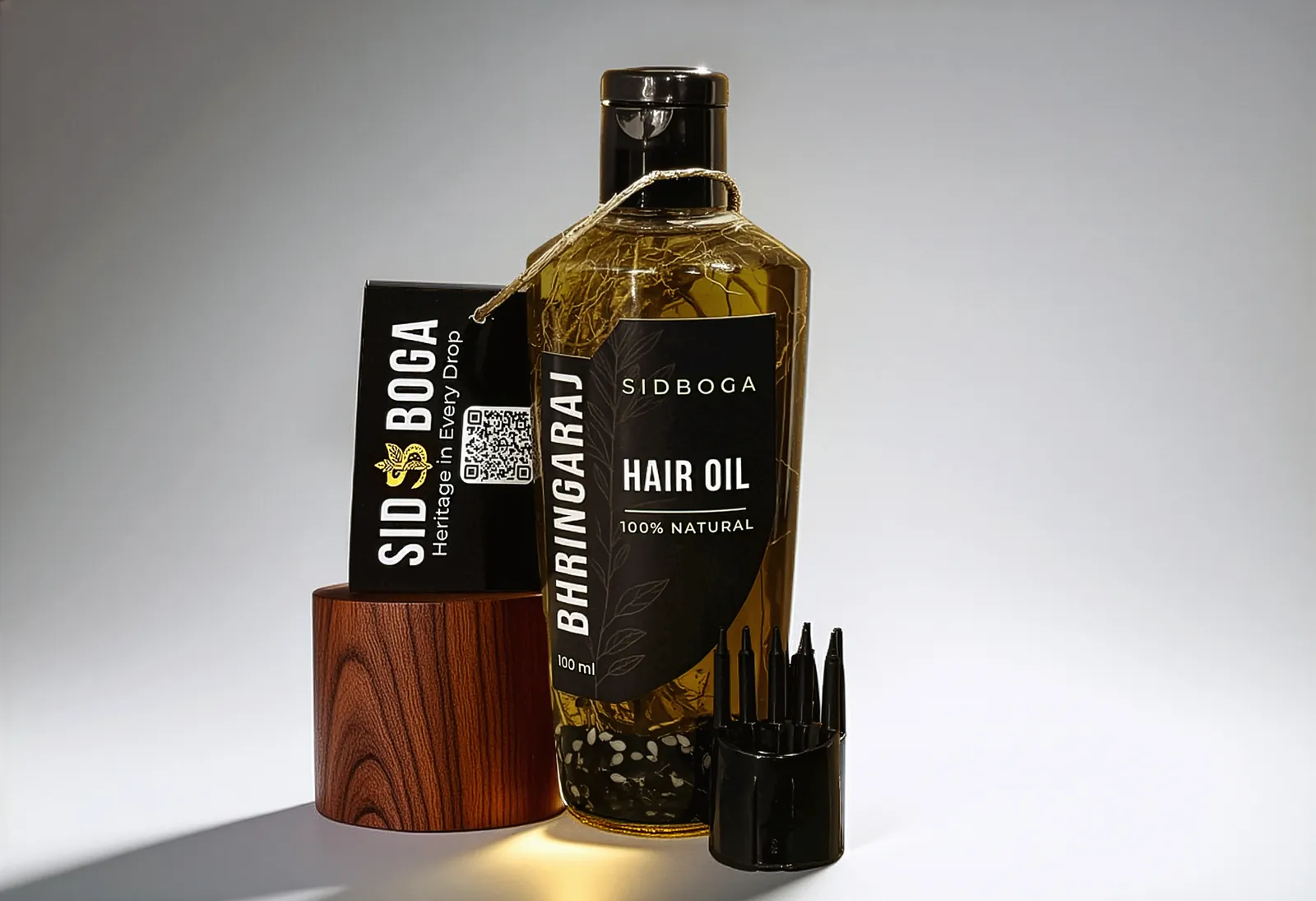
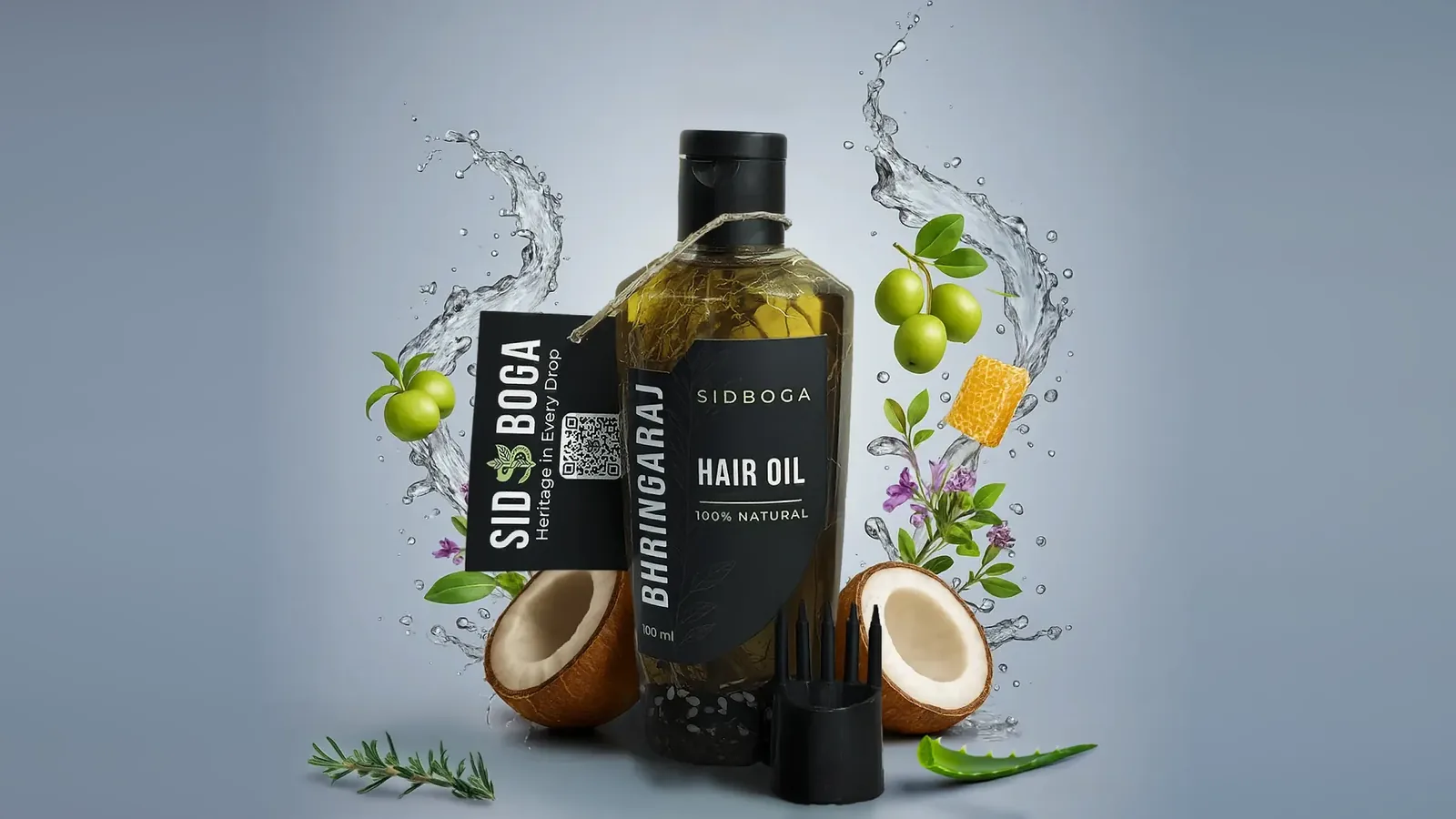
SidBoga's Bhringraj Hair Oil is formulated with 20+ traditional Ayurvedic herbs and natural oils infused into a base of cold-pressed coconut oil, gingelly oil, and castor oil. These base oils naturally contain Vitamin E in its most bioavailable form.
Additionally, several of the herbs used in SidBoga's formulation are themselves rich in natural antioxidants:
- Bhringraj (Eclipta alba): Contains wedelolactone and other polyphenolic antioxidants
- Gooseberry (Amla): One of the richest natural sources of Vitamin C, a powerful antioxidant that works synergistically with Vitamin E
- Neem: Contains quercetin and other flavonoids with antioxidant properties
- Fenugreek: Natural source of Vitamin E, flavonoids, and alkaloids
- Rosemary: Contains carnosic acid and rosmarinic acid — potent natural antioxidants studied for their hair growth benefits
Because SidBoga relies on these naturally occurring antioxidants rather than externally added synthetic compounds, the oil remains genuinely, verifiably 100% natural.
Common Myths vs. Facts
Myth: "Adding Vitamin E capsules makes my hair oil more effective"
Fact: Vitamin E in capsule form is typically tocopheryl acetate — an ester that cannot act as an antioxidant in its ester form when applied topically. The oral de-esterification process (by gut enzymes) doesn't apply to topical use. Your cold-pressed base oil already contains active, free-form Vitamin E.
Myth: "If it says 'Natural Vitamin E' on the capsule, it's natural"
Fact: Even "natural" Vitamin E supplements undergo industrial extraction, purification, and often methylation (chemical conversion of gamma-tocopherol to alpha-tocopherol). The capsule itself contains gelatin, glycerin, and potentially synthetic additives. The Vitamin E inside may be natural in origin, but the product has been heavily processed.
Myth: "Synthetic Vitamin E is exactly the same as natural"
Fact: Synthetic dl-alpha-tocopherol has approximately 50% of the biological potency of natural d-alpha-tocopherol, according to the U.S. Institute of Medicine and EFSA. It contains 7 unnatural stereoisomers. Scientifically, they are NOT the same molecule.
Myth: "There's no harm in adding Vitamin E capsules to hair oil"
Fact: While unlikely to cause serious harm in most people, published dermatological research documents cases of allergic contact dermatitis from topical Vitamin E derivatives. If you have a sensitive scalp, this is a real risk. Additionally, the capsule introduces non-natural additives to your oil.
A Quick Checklist: Is Your Hair Oil Truly 100% Natural?
Ask these questions before buying:
- Does the ingredient list mention "dl-alpha-tocopherol" or "tocopheryl acetate"? → It contains synthetic or semi-synthetic Vitamin E
- Does it list "Vitamin E" as a separate ingredient? → The Vitamin E was likely added externally, not naturally occurring in the base oils
- Are the base oils cold-pressed? → Cold-pressing preserves natural Vitamin E; chemical extraction (using hexane solvents) destroys much of it
- Does the brand disclose their full ingredient list? → Transparency is a sign of genuinely natural formulations
- Does it contain artificial fragrances or preservatives? → These disqualify any "100% natural" claim
The Science-Based Bottom Line
Let's summarise what the evidence tells us:
- Synthetic Vitamin E (dl-alpha-tocopherol) is derived from petroleum products — specifically toluene, processed with hydrogen chloride gas (EFSA, 2012)
- Vitamin E capsules contain additives beyond just tocopherol — including gelatin, glycerin, carrier oils, and potentially synthetic preservatives like BHT
- Tocopheryl acetate (the common capsule form) is inactive as a topical antioxidant because the hydroxyl group is esterified
- Cold-pressed plant oils naturally contain Vitamin E in its active, free tocopherol form — no external addition needed
- Adding Vitamin E capsules to hair oil and calling it "100% natural" is misleading — regardless of whether the tocopherol itself was plant-derived or synthetic
- Allergic contact dermatitis from topical Vitamin E derivatives is documented, though incidence is low
The takeaway? True "100% natural" means every ingredient occurs naturally in the formulation — not added from an external, industrially processed source. If your hair oil needs external Vitamin E to stay fresh, that might indicate the base oils were refined (not cold-pressed) and have lost their natural antioxidant content.
Choose Genuinely Natural
SidBoga's Bhringraj Hair Oil is crafted using traditional methods with cold-pressed oils and 20+ authentic Ayurvedic herbs. The natural Vitamin E, polyphenols, and flavonoids in these ingredients provide genuine antioxidant protection — no synthetic capsules, no petroleum derivatives, no misleading labels.
- SidBoga Bhringraj Hair Oil (100ml): LKR 1,500 — 20+ Ayurvedic herbs and natural oils including Bhringraj, Rosemary, Neem, Amla, Fenugreek
- Triple Bundle Pack (3 × 100ml): LKR 4,000 — Save LKR 500
- Free island-wide delivery across Sri Lanka
Order at sidboga.com/products — because your hair deserves ingredients that are natural by nature, not by label.
References & Sources
- EFSA Scientific Opinion on synthetic alpha-tocopherol (2012) — EFSA Journal 10(7)
- EFSA Scientific Opinion on tolerable upper intake level for Vitamin E (2024) — EFSA Journal 22(8)
- Jensen S, Lauridsen C. "α-Tocopherol Stereoisomers." Vitamins & Hormones, Vol. 76 (2007)
- Kosari P, Alikhan A, et al. "Vitamin E and allergic contact dermatitis." Dermatitis 21(3), 2010
- Brigelius-Flohé R, Traber MG. "Vitamin E: function and metabolism." FASEB Journal 13(10), 1999
- U.S. NIH Office of Dietary Supplements — Vitamin E Fact Sheet for Health Professionals (2021)
- U.S. Institute of Medicine — Dietary Reference Intakes for Vitamin E (2000)